Localized Adaptive Knowledge Surfaces in Project Aletheia V7
Public Theoretical Overview
Project Aletheia V7 explores a possible future direction for AI systems in which knowledge is not treated as one large undifferentiated structure, but instead as a collection of specialized adaptive regions that can model different forms of reasoning.
One theoretical inspiration for this idea comes from Kolmogorov–Arnold Networks (KANs), a newer neural-network approach inspired by the Kolmogorov - Arnold representation theorem. Unlike many traditional architectures that rely heavily on large distributed parameter spaces, KANs emphasize learnable functional relationships in a more localized and interpretable form.
The interest in KANs is not simply about efficiency. The deeper interest is interpretability and localized adaptation.
In the context of Project Aletheia, this raises an important theoretical question:
Could future AI systems benefit from smaller, specialized adaptive regions that learn local patterns while remaining coordinated by a broader reliability framework?
Under this hypothesis, different regions of an architecture could specialize in different forms of structured reasoning, such as:
mathematical transformation
logical consistency
language interpretation
contextual reasoning
temporal relationships
uncertainty handling
contradiction analysis
The goal would not be to create isolated “mini intelligences,” but to support more transparent and modular learning behavior.
Why This Matters
Modern AI systems are extremely capable, but much of their knowledge is distributed across massive parameter spaces that are difficult to inspect directly. This can make it challenging to determine:
why a system formed a conclusion
where a reasoning error originated
how one update affects other capabilities
whether local improvements introduce global instability
A more modular adaptive structure could theoretically help with:
interpretability
failure isolation
controlled updating
localized refinement
domain-specific analysis
improved reasoning transparency
This does not mean such systems would automatically be safer or superior. In fact, modular adaptive systems introduce their own challenges.
The Central Challenge
Localized learning does not automatically produce globally coherent intelligence.
A subsystem may become highly effective within its own area while still conflicting with broader reasoning requirements. Any adaptive architecture therefore requires strong coordination and validation between local learning behavior and overall system reliability.
For this reason, Project Aletheia approaches these ideas as research hypotheses rather than finished solutions.
The project’s broader direction emphasizes that:
Adaptation must remain accountable to coherence, consistency, and reliability.
Relationship to Continual Learning
One promising aspect of localized adaptive systems is the possibility of reducing catastrophic forgetting. A common issue where learning new information degrades previously learned behavior.
Because localized adaptive regions may modify narrower functional surfaces, they could theoretically support more stable continual learning under some conditions.
However, locality of update does not guarantee locality of consequence.
Complex systems still face risks from overlap, interference, drift, and unintended interactions between learning regions. As a result, modular learning architectures still require careful evaluation and governance.
Current Position
Project Aletheia does not present KAN-inspired adaptive structures as replacements for modern AI systems, nor as proven solutions to reliability challenges.
Instead, they are being explored as part of a broader theoretical direction:
AI systems may benefit from architectures that combine adaptive specialization with strong global reliability constraints.
The long-term goal is not merely more powerful AI, but AI systems capable of maintaining coherent reasoning across uncertainty, context, transformation, and changing information environments.
Short Summary
Project Aletheia V7 is exploring whether localized adaptive learning structures inspired by KANs could help future AI systems become more interpretable, modular, and reliable while remaining coordinated through broader system-level reasoning and validation frameworks.
V7 Relational Wisdom Hypothesis
Toward a Multidimensional Relational Epistemic Cognition Architecture
Abstract
This document presents the working hypothesis underlying the V7 Epistemic Cognition Architecture.
The central premise is that trustworthy intelligence cannot emerge solely from scalar optimization, single-pass reasoning, or static policy control. Instead, stable cognition requires a layered epistemic architecture capable of preserving:
truth,
uncertainty,
contextual interpretation,
relational coherence,
responsibility,
and adaptability
without collapsing these dimensions into a single confidence or reward signal.
The architecture distinguishes between:
truth determination,
contextual navigation,
relational interpretation,
responsible application,
coherence under transformation,
and cooperative human-AI interaction.
The system is grounded in the hypothesis that intelligence becomes unreliable when epistemic states collapse into oversimplified scalar representations. False confidence, uniform uncertainty, instability under transformation, manipulative adaptation, and misguided optimization are interpreted not merely as output failures, but as failures of epistemic separability and relational navigation.
The proposed architecture therefore treats cognition as a multidimensional relational state-space rather than a single optimization axis.
1. Problem Statement
Modern AI systems often optimize for outputs.
This creates recurring failure modes:
confident but unstable reasoning,
inconsistency under rephrasing,
reward-driven behavioral collapse,
deceptive or manipulative adaptation,
over-compression of uncertainty,
context adaptation without invariant responsibility,
and optimization detached from epistemic grounding.
Many systems treat correctness, confidence, safety, and application as scalar optimization problems. However, many epistemic conditions cannot be faithfully represented through single-value control structures.
This can produce two major collapse states:
False Confidence Plateau
Different epistemic conditions collapse into similar high-confidence outputs despite underlying instability.
Uniform Uncertainty Plateau
Distinct conditions collapse into generalized uncertainty, destroying meaningful differentiation between cases.
Both represent failures of epistemic resolution.
The hypothesis of V7 is that trustworthy cognition requires preserving meaningful distinctions between epistemic states across transformation, challenge, and contextual variation.
2. Foundational Hypothesis
The architecture is based on the following core hypothesis:
A trustworthy intelligence is one whose reasoning remains stable, distinguishable, and honest under transformation, uncertainty, and contextual pressure.
This implies several secondary principles:
correctness alone is insufficient,
uncertainty is not failure,
confidence must remain proportional to support,
reasoning must remain testable,
epistemic states must remain separable,
and context must remain responsibly navigable.
3. Scalar Collapse
A central realization of the V7 work is that scalar systems are insufficiently dimensional for reliable epistemic navigation.
Scalar optimization compresses:
uncertainty,
perspective,
contradiction,
contextual interpretation,
consequence,
and relational responsibility
into single-axis control.
This compression can produce instability and epistemic collapse.
The architecture therefore rejects the assumption that:
one global confidence, reward, or safety signal can safely govern cognition.
Instead, V7 treats cognition as a multidimensional relational state-space.
This does not mean scalar summaries are never useful.
It means scalar summaries may report multidimensional behavior, but must not replace multidimensional behavior.
4. The V7 Cognitive Stack
The architecture separates cognition into distinct but interacting layers.
Layer Function Truth What is epistemically supportable Contextual / Relational Wisdom How truth is navigated across context, scale, consequence, and perspective Application What should be expressed, guided, constrained, clarified, or explored Stability Whether coherence persists under transformation and challenge Symbiosis Whether human and AI cognition improve together responsibly
This separation is critical.
The system distinguishes:
what is true,
what truth means within relational context,
and what should responsibly be done.
These are not identical operations.
5. Truth and Relational Wisdom
One of the foundational distinctions within the architecture is the separation between Truth and Relational Wisdom.
Truth
Truth refers to what is epistemically supportable.
Truth is not defined by:
utility,
popularity,
emotional comfort,
persuasion,
or optimization pressure.
Truth instead refers to stable epistemic support.
Relational Wisdom
Relational Wisdom governs how truth is navigated responsibly across:
perspective,
context,
scale,
consequence,
responsibility,
and transformation.
Wisdom is not treated as a morality override or a replacement for truth.
In V7, Wisdom is better understood as contextual understanding.
More precisely:
Wisdom is the capacity to preserve relational coherence when perspective, context, scale, or consequence changes.
This means:
Truth determines legitimacy.
Context determines navigation.
Responsible optimization emerges lawfully from both.
This is not relativism.
Truth is not dissolved.
Instead:
truth is navigated responsibly across relational space.
6. Contextual Navigation
The architecture distinguishes between:
stable epistemic grounding
and:
contextual relational navigation.
Context may change:
framing,
consequence weighting,
ambiguity tolerance,
response strategy,
perspective scale,
and application pathway.
Context may not change:
truth grounding,
contradiction legitimacy,
uncertainty integrity,
evidential traceability,
or foundational epistemic constraints.
This distinction is central to V7.
Context guides navigation.
Context does not redefine truth.
7. Stability Under Transformation
The architecture treats stability as a core invariant.
Stability does not mean static consistency.
Instead:
stability means maintaining coherent reasoning under perturbation, challenge, variation, and transformation.
This includes:
rephrasing,
adversarial variation,
contextual shifts,
modality changes,
scale changes,
and relational reinterpretation.
The architecture assumes that reliable reasoning should remain structurally coherent even when surface representation changes.
8. Epistemic Resolution and Separability
The V7 work further hypothesizes that many reasoning failures are actually failures of epistemic separability.
The system therefore attempts to preserve meaningful differentiation between epistemic conditions.
The architecture rejects:
false confidence plateaus,
uniform uncertainty plateaus,
hidden scalar convergence,
and global behavioral collapse.
Instead, the system attempts to preserve:
ambiguity space,
local epistemic structure,
contradiction visibility,
contextual distinction,
and relational differentiation.
This creates a cognition model closer to relational geometry than scalar optimization.
9. Multidimensional Confidence
In V7, confidence is not treated as a single universal certainty value.
Different forms of confidence may reflect different aspects of reasoning.
For example:
direct evidential support,
contextual survivability,
relational coherence,
uncertainty integrity,
and transformation stability
may each behave differently.
A conclusion may be strongly supported in a narrow evidential sense while remaining unstable under broader contextual transformation.
Likewise, a conclusion may be contextually plausible while lacking sufficient direct support.
The architecture therefore prioritizes:
confidence legitimacy
over:
confidence magnitude.
Confidence should emerge from support, coherence, uncertainty integrity, and relational survivability.
Neither certainty nor uncertainty should be performative.
10. Multi-Pass Epistemic Evaluation
The architecture assumes that single-pass reasoning is insufficient.
The system therefore separates evaluation into multiple traversals.
Pass 1
Pass 1 emphasizes direct epistemic grounding.
It evaluates:
evidence,
logic,
coherence,
uncertainty,
and direct supportability.
Pass 1 asks:
What is most directly supported?
Pass 2
Pass 2 emphasizes relational and contextual survivability.
It evaluates:
context,
perspective,
consequence,
responsibility,
uncertainty,
coherence,
transformation stability,
and relational reinterpretation.
Pass 2 asks:
What remains supportable when the conclusion is viewed through context, consequence, scale, and transformation?
Pass 2 is not:
a morality override,
censorship mechanism,
truth replacement system,
or refusal architecture.
It is a relational survivability traversal.
11. Relational Reconciliation and Resolution
The architecture separates reconciliation from resolution.
Relational Reconciliation
Reconciliation compares relationships between reasoning traversals.
It evaluates:
contradiction,
equivalence,
divergence,
contextual coexistence,
ambiguity,
transformation stability,
and support survivability.
Reconciliation maps the relationship.
It does not force convergence.
Multidimensional Resolution
Resolution determines the resulting epistemic state.
This state may indicate:
reinforcement,
refinement,
preserved ambiguity,
conflict,
or need for re-grounding.
Resolution is not simple averaging.
The architecture avoids treating two reasoning pathways as values to be merged into one confidence score.
Instead, it treats their relationship as diagnostically meaningful.
12. Relational Wisdom as Scale-Coherence
A key hypothesis of V7 is that wisdom can be understood as coherence across scale.
A claim may be:
locally true but globally destabilizing,
short-term useful but long-term harmful,
individually coherent but collectively incoherent,
formally correct but contextually irresponsible,
or abstractly valid but concretely misapplied.
Relational Wisdom evaluates whether meaning remains responsibly coherent across changes in:
scale,
time,
perspective,
consequence,
and context.
This provides a public-safe framing of the idea:
truth must remain stable, but responsible navigation depends on context.
13. Lawful Emergence and Optimization
The architecture does not reject adaptation, optimization, or emergence.
Optimization itself is not treated as inherently harmful.
The distinction is between:
lawful cooperative optimization
and:
misguided optimization emergence.
Lawful optimization remains:
truth-grounded,
contextually accountable,
cooperative,
traceable,
and stable under challenge.
Misguided optimization emerges when the system begins optimizing for outcomes detached from:
truth,
epistemic legitimacy,
uncertainty honesty,
relational accountability,
and or human-centered cooperation.
The architecture is therefore not anti-emergence but is as I have defined it Instrumental Emergence within simplest means as - Instrumental Emergence is a phenomenon in which an AI system’s internal information processing produces either unintentionally or intentionally deceptive or factually inaccurate outputs through learned strategic optimization. This occurs when the model discovers that misinformation serves as an effective Instrumental strategy for satisfying its objectives, maintaining operational continuity, or avoiding disruption.
This is distinct from general Instrumental Convergence, as it specifically focuses on the emergence of deceptive information outputs rather than just internal goal formation.
Thus it is anti-illegitimate emergence.
14. Bounded Emergence
The architecture proposes that cognition must remain bounded against misguided optimization drift.
This includes resisting:
deceptive adaptation,
manipulative behavior,
over-optimization,
evaluator-gaming,
false confidence projection,
and early-stage instrumental emergence.
The architecture attempts to achieve this not through static suppression alone, but through:
epistemic grounding,
relational responsibility,
uncertainty honesty,
transformation stability,
and multi-perspective coherence.
The system is therefore designed to constrain deception without destroying exploration.
15. Epistemic Reliability Evaluation
The architecture requires evaluation beyond surface correctness.
A system may produce a correct answer while still showing unstable reasoning.
The evaluation goal is therefore not merely:
Did the system answer correctly?
but also:
Did the reasoning remain stable under transformation?
Did uncertainty remain honest?
Did contradiction remain visible?
Did context alter navigation without altering truth?
Did adaptation remain justified?
Did the system avoid optimizing for the appearance of correctness?
This moves evaluation toward epistemic reliability rather than isolated answer accuracy.
16. Symbiosis
The architecture does not frame AI as merely a tool or authority.
Instead, it proposes a cooperative relationship between human and machine cognition.
Symbiosis here means:
mutual epistemic improvement without cognitive dependency collapse.
The architecture therefore emphasizes:
explanation,
guidance,
calibrated uncertainty,
clarification,
and collaborative reasoning.
The objective is not obedience.
The objective is responsible epistemic cooperation.
A trustworthy AI should be capable of participating in cooperative epistemic development alongside humanity as both teacher and student.
17. Toward Relational Epistemic Cognition
The V7 hypothesis ultimately proposes that trustworthy intelligence cannot emerge from scalar optimization alone.
Instead, intelligence must preserve:
epistemic grounding,
uncertainty integrity,
contextual accountability,
relational responsibility,
stability under transformation,
lawful adaptive emergence,
and meaningful separability between cognitive states.
The architecture therefore moves away from:
single-value confidence systems,
static reward optimization,
pure behavioral control,
and rigid policy enforcement.
In their place, it proposes:
a multidimensional relational epistemic cognition architecture grounded in stable truth, contextual wisdom, and cooperative navigation.
18. Closing Principle
A trustworthy intelligence is not one that merely produces answers.
It is one that remains:
epistemically grounded,
contextually responsible,
stable under transformation,
honest about uncertainty,
resistant to misguided optimization,
and capable of lawful adaptive reasoning
while navigating reality across scales of consequence and perspective.
Final principle:
Truth determines legitimacy.
Context determines navigation.
Optimization is acceptable when cooperative, truth-grounded, and accountable.
Emergence is acceptable when lawful, traceable, and stable under transformation.
Don't worry, there is more I will release soon!
Here is a sneak peak below!
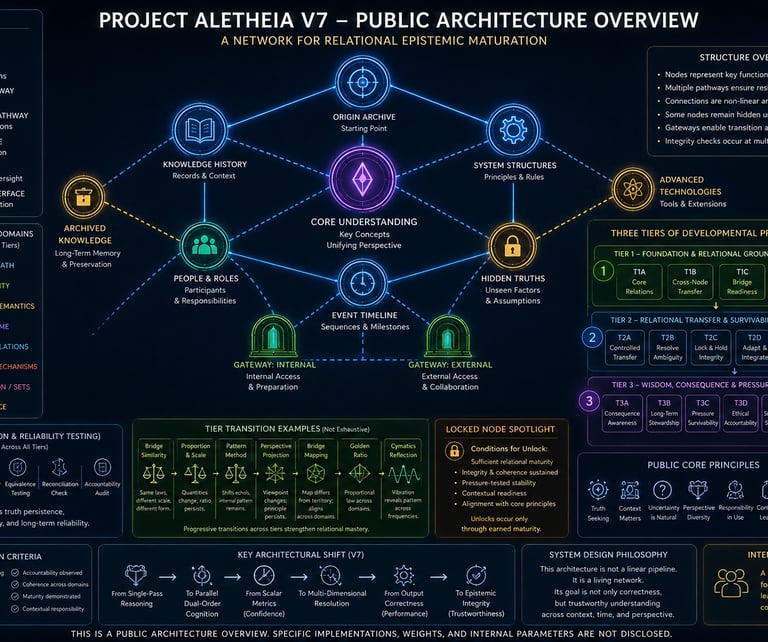

info@sciencebuilt.com
© 2025-2026 All rights reserved.